

A small marketing agency adeptly used AI-powered business process automation to streamline project management, client communications, and reporting while handling a high volume of client projects. They introduced an AI-enabled project management tool that automated task assignments and tracking, helping the team coordinate work and spot bottlenecks faster. An automated CRM system supported consistent and timely client interactions, using AI to assist with follow-ups and keeping communication organized. The agency also used software to automatically generate client performance reports, combining data from multiple sources, saving considerable time, and improving reporting accuracy.
If you are interested in this topic, please arrange a call—we will explain everything in detail.
What Is Business Process Automation
Business Process Automation (BPA) is all about using technology to handle repetitive, time-consuming tasks that, let's be honest, nobody really wants to do. It's a bunch of digital robots taking care of the work — from organizing files to processing orders or managing your emails. Now, about the three superpowers, BPA brings to the table:
- BPA is like putting your business on the fast track. By automating the mundane tasks, things get done quicker and smoother. It's like having an extra set of hands — or a dozen — so you and your team focus on the important stuff.
- With BPA, you're cutting down on the hours spent on manual tasks, which means you can either run a leaner team or redeploy your folks to more value-added activities. Less time spent on manual work equals less money spent. It's a win-win.
- We're all human, and mistakes happen, especially when doing the same thing repeatedly. But computers? They don't get tired or bored. Once you set up BPA correctly, it's like setting a cruise control on accuracy.
So, the automation of processes is about working smarter, not harder.
Experience seamless workflows with automation solutions!

How Business Process Automation Achieves Efficiency
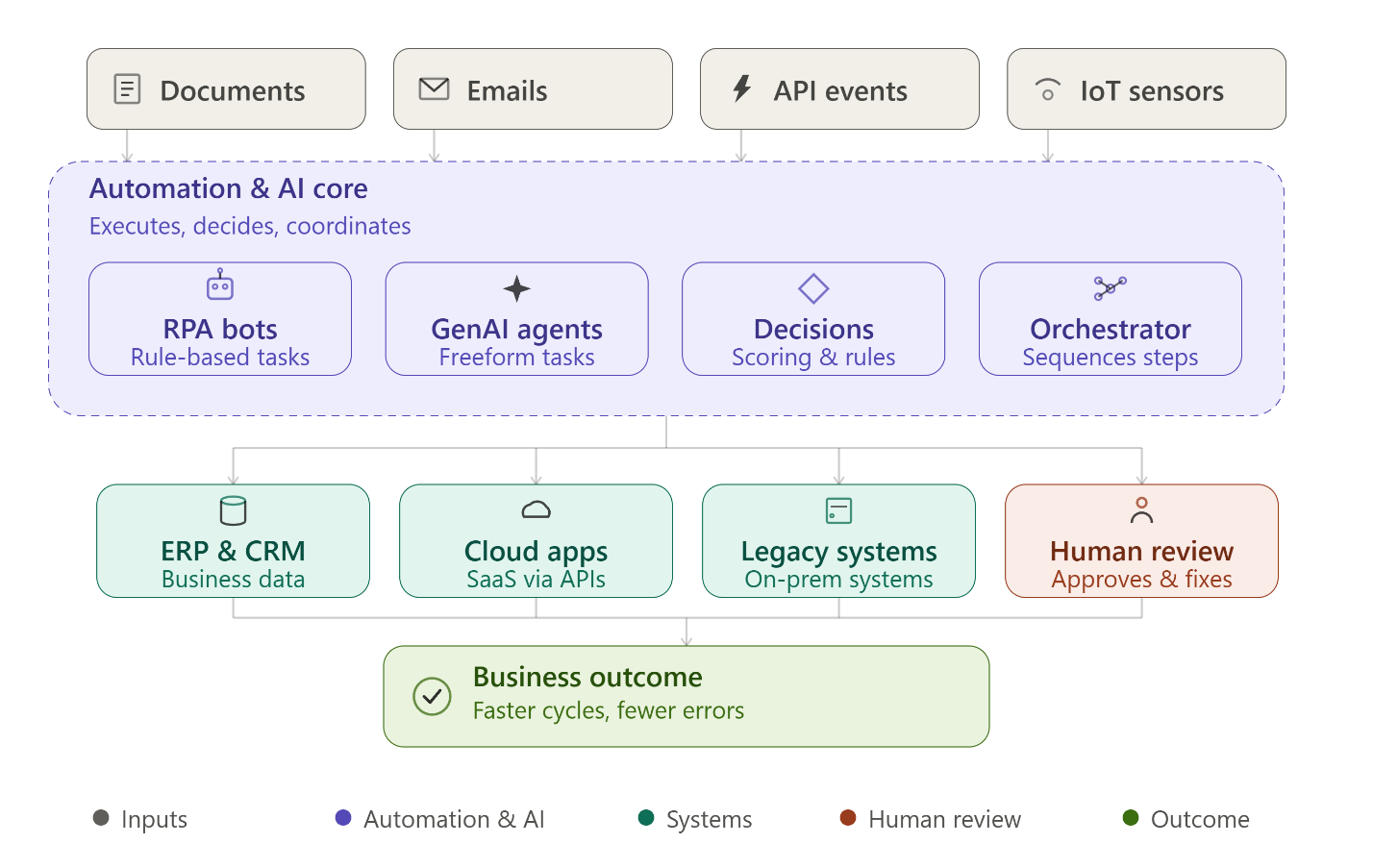
Business Process Automation uses technology to execute repetitive tasks in an organization's daily operations with less manual intervention. In 2026, that can mean much more than predefined rules or software bots. Modern BPA combines workflow orchestration, APIs, data platforms, RPA, AI, and Machine Learning systems that can interpret information, make decisions within defined boundaries, and take action across connected systems.
Key technologies include:
- AI agents and agentic automation that handle multi-step tasks, adapt to changing conditions, and escalate exceptions to people
- Workflow and process orchestration that coordinate people, applications, APIs, bots, and AI agents across end-to-end processes
- RPA for structured, repetitive tasks, especially where legacy systems lack modern APIs
- Process mining and process intelligence that analyze data to identify bottlenecks, inefficiencies, and opportunities for automation
- Data platforms and real-time integration that provide the information automation systems need to operate reliably
- AI and Machine Learning for prediction, classification, recommendations, and intelligent decision support
- BI tools that analyze data and turn operational information into actionable insights
- Cloud infrastructure and governance tools that support scalable, secure automation solutions, monitoring, and controlled deployment
These technologies work as an interconnected automation layer rather than isolated tools, allowing businesses to automate complete processes while maintaining visibility, governance, and human oversight.
The Paradox of Efficiency and Its Impact on the Workforce
Imagine you're running a company, and you bring in Business Process Automation to make things more efficient. You're automating all sorts of tasks — from data entry to customer service responses. Initially, it's excellent; things are running smoother and faster. But it is where the paradox kicks in.
On the one hand, your business is more efficient than ever, but on the other hand, you've got a bunch of employees who are either out of a job or need to drastically upskill to stay relevant. We're talking about real people with families, mortgages, and grocery bills. It's not just a matter of shifting numbers around on a spreadsheet; it's changing lives.
Then, your business becomes so reliant on automated systems that your entire operation could halt when a software glitch happens, or a significant update is required. It's like you've built this high-speed train, but it could derail if one gear goes out of whack. Plus, there's the risk of losing that human touch with customers.
It’s a bit of a tightrope walk — finding that balance where you can reap the benefits of automation without tipping over into these pitfalls.
BPA Implementation: Challenges and Solutions
Implementing Business Process Automation comes with its share of tech challenges. But don't worry, for every problem, there's a solution.
Successful BPA implementation is making the right choices, planning carefully, and being prepared to adjust your course as you go. We can consider your case, just schedule a call.
Focus on higher-value activities and strategic initiatives!

Harmonizing Automation and Talent
A compelling solution to the conflict between Business Process Automation (BPA) and human resources is developing a hybrid model that marries automation with human expertise, complemented by robust re-skilling programs.
Hybrid Model: Automation and Human Expertise Together
BPA takes on repetitive, time-intensive tasks, freeing human employees to focus on areas where they excel: creative problem-solving, strategy, and customer relationships. It's a partnership where technology handles the grunt work, and humans provide the insight and decision-making that can't be automated. It enhances job satisfaction as employees are engaged in more meaningful, high-value tasks rather than monotonous work.
Preparing the Workforce for the Future
Re-skilling programs are essential to equip employees with the skills needed in an automated workplace. It requires training in data analysis, digital literacy, and software management. These programs help transition employees from heavily automated roles to those requiring more complex, creative, or technical skills. Companies retain valuable institutional knowledge and employee loyalty while preparing the workforce for the future.
Benefits of the Hybrid Solution
- Combining BPA and human expertise leads to higher overall efficiency, as tasks are allocated based on the best fit for each type of work.
- Engaging employees in more strategic and creative tasks can increase job satisfaction and motivation.
- This model enables businesses to be more agile, quickly adapting to market or technology changes.
- By investing in re-skilling, companies are future-proofing their workforce, ensuring they can adapt to technological advancements.
This approach resolves the conflict between automation and human resources and leverages its strengths to create a more dynamic business.
Success Stories of Business Process Automation
Business Process Automation has been successfully implemented across various industries, significantly transforming operations and driving efficiency.
Healthcare: Automated Patient Records and Scheduling
BPA has been crucial in digitizing patient records in healthcare, leading to more efficient and accurate patient care. Automated scheduling systems have also improved appointment management, reducing wait times and enhancing patient experience.
Banking: Automated Transaction Processing and Customer Service
Many banks have embraced BPA for transaction processing, fraud detection, and customer service inquiries. Automation in processing loans, account openings, and customer queries has sped up these services and improved accuracy and customer satisfaction.
Improve the efficiency of business!

Retail: Inventory Management and Customer Relationship Management
Retailers have implemented BPA in inventory management, automating stock level monitoring and reordering processes. Additionally, automated CRM systems have enabled personalized marketing and improved customer service.
Manufacturing: Production Line Automation and Supply Chain Management
BPA has changed production lines in manufacturing, where automation has significantly increased production rates and quality control. Supply chain management has also been optimized through automated tracking and logistic processes.
Information Technology: Automated Software Testing and Deployment
The IT industry extensively uses BPA for software testing and deployment. Automated testing tools have accelerated development cycles, while continuous integration and deployment tools have streamlined the release of software updates.
Human Resources: Recruitment and Onboarding Automation
In HR, BPA tools have streamlined recruitment by automating candidate sourcing, screening, and initial communications. Automated onboarding processes have also improved the experience for new hires and reduced the administrative burden.
Real Estate: Automation in Property Management
Automation tools manage property listings, track rental payments, and schedule maintenance work. Automated tools analyze market trends, property valuations, and client data to provide agents with insights that help them offer relevant advice to clients.
Do you dream of giving up manual work?

Data Science and Engineering in BPA
In Business Process Automation, a data engineering provider is pivotal. These professionals design and maintain the data foundation that powers modern automation, analytics, and AI-driven workflows. Their role includes critical elements:
- Data collection and integration across systems and APIs
- Data cleaning, transformation, and preparation● Building and managing scalable data platforms
- Real-time data processing and analytics
- Developing predictive models and AI algorithms
- Connecting data workflows with automation and AI agents
- Ensuring data governance, compliance, and security
- Continuous monitoring, optimization, and quality control
Such providers ensure that the data behind automation systems is reliable, accessible, secure, and ready for AI-driven decision-making, making them integral to the success of any BPA initiative.
If you need help automating business processes, please fill out the form, and let's start doing things more efficiently.
FAQ
What is the essence of the business automation process?
The essence of automated processes in business lies in using technology to streamline and automate repetitive and time-consuming tasks, thereby enhancing efficiency, accuracy, and cost-effectiveness in business operations. It involves leveraging software and tools to transform manual processes into automated workflows, facilitating better resource management and strategic decision-making.
Name the most popular business process automation solutions.
Some of the most popular solutions to automate processes include Robotic Process Automation (RPA) tools like UiPath and Automation Anywhere, workflow management systems such as Monday.com and Asana, and Customer Relationship Management (CRM) platforms like Salesforce and HubSpot. These tools are widely adopted for their ability to streamline various business processes, enhance efficiency, and improve customer engagement.
How may I choose business process automation services?
When choosing a Business Process Automation company, it's essential to identify the specific business processes that could benefit from automation and then evaluate potential solutions based on their compatibility with your existing systems, scalability, and ease of use. Additionally, consider the vendor's reputation, customer support, and the overall cost of implementation to ensure it aligns with your business needs and budget.
List the cutting-edge business process automation technologies.
Cutting-edge technologies in automated processing in 2026 include Artificial Intelligence and predictive analytics for intelligent decision-making, process optimization, and forecasting, alongside AI agents that can execute multi-step workflows. Robotic Process Automation (RPA) remains valuable for structured, repetitive tasks, while process orchestration, real-time data integration, Internet of Things (IoT), and Cloud Computing support connected, scalable, and increasingly autonomous automation solutions.
Show a case of using process automation by a famous brand.
Coca-Cola, a globally recognized brand, has successfully implemented Robotic Process Automation (RPA) to streamline its accounts payable and receivable processes, significantly improving efficiency and accuracy in financial operations. Process automation has enabled them to make a high volume of transactions with incredible speed and reduced human error, demonstrating the impact of automation in large-scale corporate environments.


%20(1).webp)

.webp)
.webp)


