


Choosing the right data integration approach dictates your cloud compute overhead and downstream latency. Pick the wrong pipeline—your predictive models starve. Nail it: your infrastructure scales cleanly, data quality stays pristine, and engineers stop babysitting brittle data flows. This isn't a mere technical toggle. It is the baseline for your entire business strategy.
Schedule a call to complement reality with a profitable solution.
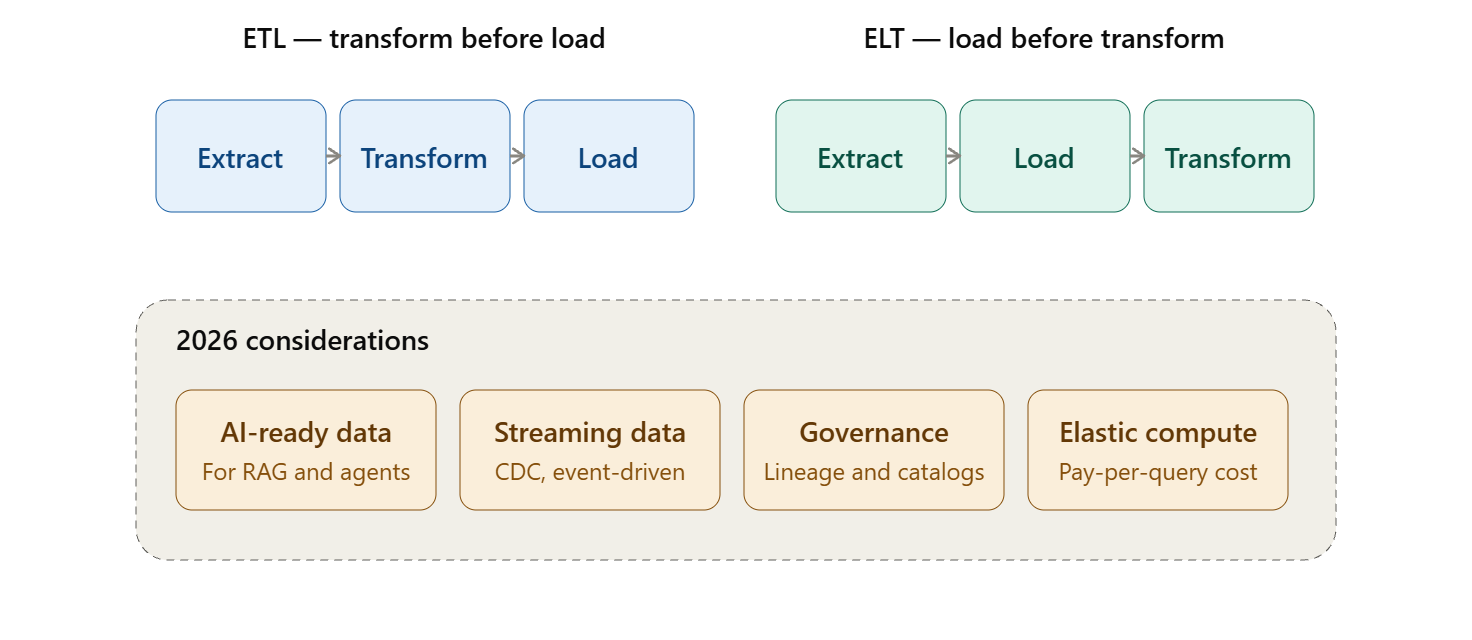
ETL runs transform-then-load — better where compliance or schema control matters upfront. ELT dumps raw data first and transforms inside the warehouse/lakehouse — the default for cloud-scale and flexible modeling.
In the Data Kitchen — ETL and ELT as Cooking Styles
Comparing the key ETL and ELT differences is contrasting traditional meal preparation, where you prep ingredients before cooking, with a flexible approach that lets you cook first and decide how to season as you go.
ETL versus ELT: Data Transformation Strategies
Using a kitchen analogy, let's explore the contrasting approaches to data storage and processing in traditional ETL and the modern ELT method.
Choose the Right ETL or ELT Strategy for Your Growth

Preparing a Gourmet Meal
Picture you're preparing a gourmet meal. In the ETL approach, you start by carefully selecting and prepping all the ingredients on your countertop. You wash, chop, season, and even marinate them meticulously before you turn on the stove. The idea is to transform these ingredients into their best possible state before touching the cooking pan.
In the data world, you first extract data from various sources (selecting ingredients), then you meticulously clean, aggregate, format, and structure it (prepping and marinating), ensuring it's in the ideal state for analysis or storage. After this meticulous preparation, you load the transformed data into a target data warehouse or storage system.
Cooking with Versatility
Now, you're a versatile cook who starts by placing raw ingredients directly into the oven. You spend only a little bit of time on elaborate preparation upfront. Instead, you begin the cooking process, and as the ingredients cook, you decide how to transform them based on what's needed. This method allows you to experiment, making it flexible and efficient.
In the data context, you extract data and load it directly into your target storage system (a data warehouse or a cloud-based storage). Data is stored in a raw form. The transformation occurs within this storage system, allowing you to analyze or process it as needed. It's cooking with raw ingredients and deciding how to use them while they're on the stove.
ETL's Precision or ELT's Flexibility
Let's compare the ETL approach's pre-defined data transformations with the ELT's ability to handle diverse and large-scale datasets.
- ETL calls for pre-defined data transformations where data is extracted, transformed according to specific requirements, and then loaded into the target storage system. These transformations are typically established in advance and are consistent for each data source. It ensures data quality and consistency but may not be as adaptable to diverse or large-scale datasets without extensive customization.
- In ELT, data is extracted and loaded into the target storage system in raw form without extensive pre-processing. Users then apply transformations and queries as needed, utilizing the scalability of modern data warehouses and big data platforms. ELT's flexibility makes it well-suited for handling diverse and large-scale datasets, as it adapts to the specific needs of each analysis or query.
It's like choosing between a curated cookbook collection or a library that welcomes all types of books and allows readers to shape their reading experience. For the same purpose, you can book a call to us.
Assembly Line vs. Robotic Precision
ETL excels in maintaining data quality and consistency but may introduce latency. ELT takes advantage of modern data processing capabilities, efficiently handling diverse data processing needs, much like a cutting-edge automated factory.
- ETL means a separate transformation layer where data is extracted, brought to the transformation phase, cleaned, structured, and enriched according to pre-defined rules, and finally loaded into the target storage or data warehouse. It's building customized food processors piece by piece before they're ready.
- In ELT, data is loaded into the target storage system without extensive pre-processing. Here, powerful data processing technologies, like distributed computing and parallel processing, handle the transformations on the fly. ELT processes data efficiently and adapts to diverse tasks without a separate transformation layer.
The choice between ETL and ELT depends on your data processing requirements, scalability, and the need for real-time or on-the-fly transformations.

Balancing Advantages and Challenges in Data Integration
The advantages of ETL include data quality control and structured transformations, but it may introduce latency, while ELT offers scalability and real-time processing but may require advanced data processing technologies and skilled users.
Design a Future-Ready Data Pipeline Architecture

Exploring ETL and ELT — Strengths and Limitations
Let's highlight the advantages and strengths as well as challenges and limitations of each data integration approach:
It's something like ETL vs. ELT pros and cons.
Choosing the Right Data Integration Approach
When considering factors such as complexity, data volume, agility, and performance, ETL excels in managing complex transformations and ensuring data quality. ELT, on the other hand, is well-suited for handling large volumes of data efficiently.
The choice depends on your specific data integration needs and company capabilities.
Hybrid Data Integration — Harnessing ETL and ELT Synergy
Hybrid approaches require integrating ETL and ELT methods to leverage their respective strengths while emerging trends encompass advancements like serverless computing, data lakes, and AI-driven automation, shaping the future of data integration.
Bridging ETL and ELT for High-Quality Data Solutions
It's essential to carefully design and manage hybrid data integration solutions to ensure they meet the company’s data objectives and provide the intended benefits.
- Like ELT, data is initially extracted from various sources and loaded into a central repository, such as a data lake or a cloud-based storage system. It allows for the efficient handling of large and diverse datasets.
- Like ELT, data is loaded into storage without extensive pre-processing or transformations, maintaining the raw integrity of the data.
- After data is loaded, transformations and data processing occur as needed within the storage system. These transformations are pre-defined and structured, akin to the traditional ETL approach, or they can be flexible and adaptable, taking advantage of modern data processing technologies.
- The transformed data is then made available for analytics, reporting, and other data-driven tasks, allowing users to derive insights and value from the data.
Hybrid data approaches offer scalability, data quality control, flexibility, and real-time processing, combining the strengths of ETL and ELT methods to meet diverse data needs.
Beyond ETL and ELT: The 2026 Data Reality
The traditional data pipeline is dissolving. We are structuring entire corporate data ecosystems for Retrieval-Augmented Generation (RAG) and enterprise AI. What were once considered emerging data integration and processing trends—from data mesh topologies to robust CI/CD for data pipelines—are no longer distant paradigms: they are baseline table stakes.
Are you interested in enhanced insights through data aggregation?

Here is where modern data architecture is actually operating:
- Zero-ETL Architectures: Moving data is expensive. Modern cloud data platforms now query across transactional and analytical stores without physical pipelines, eliminating extraction latency entirely.
- AI-Native Operations: We have moved far beyond basic machine learning models simply automating data ingestion tasks. ML now dictates the operational architecture itself. If your ingestion layer cannot continuously deliver clean, categorized context to your LLMs, it is obsolete.
- Operationalized Data Fabric & CI/CD: Managing data across hybrid and multi-cloud environments requires automated governance and continuous deployment. Applying rigorous CI/CD practices to enterprise data pipelines ensures raw data is discoverable, secure, and AI-ready the moment it hits your central repository.
Are you interested in a structured and optimized environment for data analysis?

A Strategic Decision for Effective Data Management
Stop treating data integration as a simple checklist of volume and complexity. When deciding between ETL/ELT tools, you must evaluate the hard operational vectors that dictate your compute costs and model performance:
- Cloud Compute Economics: ELT shifts the transformation workload directly to your target storage system. In modern environments like Databricks or BigQuery, poorly optimized on-the-fly transformations will aggressively burn your pay-as-you-go budget. Choose ELT only if your engineers can write highly optimized, resource-aware queries.
- AI-Readiness and Latency: Do your predictive models need immediate context? ELT dominates when you require near-real-time data analysis—but only if your governance layer is airtight before the AI consumes the raw ingest.
- Governance at the Edge: ETL enforces strict data quality standards before anything hits the warehouse. ELT relies on raw data loading, which demands dynamic, automated governance policies directly on the cloud storage to prevent a data swamp.
- Engineering Bandwidth: ELT easily scales to accommodate massive data volumes. However, it requires a team fluent in modern distributed computing technologies. Match the architectural complexity to the exact technical capability of your current engineers.
Medical Lab Achieves 50% Compute Savings via Databricks Migration
.webp)

Medical Lab Achieves 50% Compute Savings via Databricks Migration
Aligning Real-World Requirements
Assessing the most suitable data integration approach for a real-world case means a comprehensive evaluation of factors: specific business objectives, the volume of data generated and processed, the variety and accessibility of data sources, and the precise analytical goals. This assessment ensures that the chosen approach aligns with the team's unique data landscape and technical capabilities, allowing for effective data management.
Between ELT and ETL with DATAFOREST
As an experienced data engineering company, DATAFOREST engineers pipelines for reality. We dissect your data landscape, technical constraints, and business objectives to prescribe the most efficient data integration approach.
ETL or ELT? The answer defines your compute costs.
Technical execution means nothing without deep project context. You must fuse architectural mechanics with the core logic of your specific goals. Combine these two disciplines—the payoff: a resilient data integration system robust enough to fuel the AI workflows of 2026.
Improve the efficiency of business!

We can help in your specific case after you fill out the form — then we will learn about your problems and solve them.
FAQ
What is the difference between ETL and ELT?
The key difference between ETL and ELT is the sequence of data transformation in the data integration process: before loading data, ETL transforms it into storage, while ELT loads data first and performs transformations within the target storage system.
Which ETL or ELT approach is more suitable for traditional data warehousing scenarios?
In traditional data warehousing scenarios, the ETL (Extract, Transform, Load) approach is typically more suitable because it emphasizes structured data transformations before data is loaded into the warehouse, ensuring data quality and consistency.
In which situations is the ELT approach preferred over the ETL approach?
The ELT (Extract, Load, Transform) approach is preferred over the ETL approach in situations where real-time or near-real-time data processing, scalability for large datasets, and flexibility in handling diverse data sources are essential.
Can ETL and ELT coexist in a data integration strategy?
ETL and ELT can coexist in a data integration strategy, allowing teams to leverage the strengths of both approaches for different aspects of their data processing needs. So, you can use the difference between ETL and ELT.
Are there any specific industries or use cases where ETL is more commonly used?
ETL (Extract, Transform, Load) is more commonly used in industries and use cases where data quality, structured reporting, and historical data analysis are critical, such as finance, healthcare, and regulatory compliance.
What are the potential cost considerations when deciding between ETL and ELT approaches?
Such approaches include infrastructure expenses, software licensing costs, data storage expenses, and the need for skilled personnel, which can vary based on the chosen approach and the team's specific requirements.


.webp)
.webp)
.webp)


