

.webp)
Today, DATAFOREST discusses the importance of data-driven AI in enhancing your products and how to implement it effectively. Also, we will cover various real-life scenarios and the benefits it brings to product companies. Interested in the update? Book a call and we'll tell you what's what.
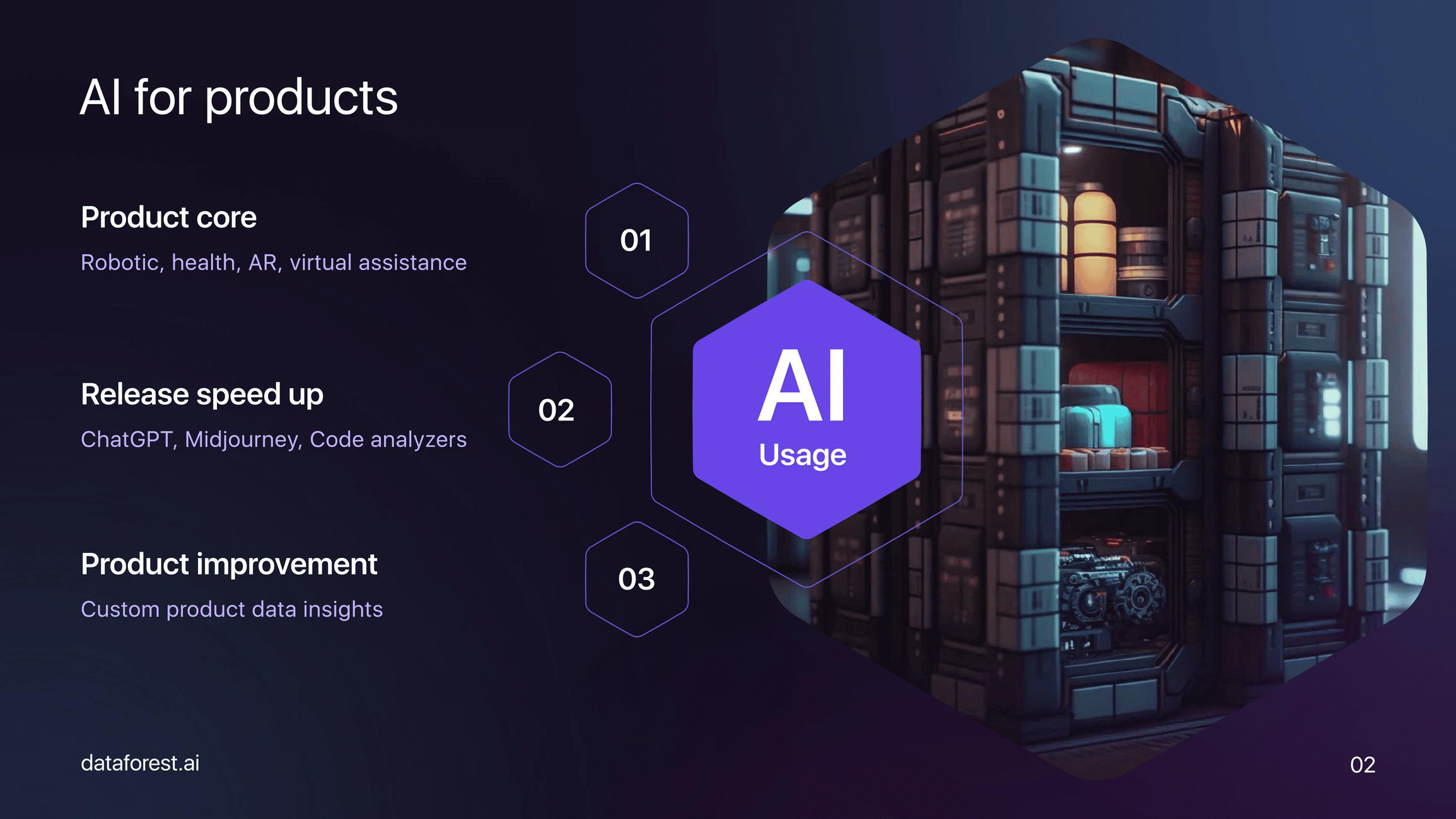
Types of AI for Products
When evaluating AI's role in product strategy today, the landscape has moved beyond basic automation. We can categorize AI integration into three main pillars:
- AI as the Product Core (Agentic & Multimodal Services): In these products, AI is the primary value proposition. Moving past the basic virtual assistants and simple trackers of the early 2020s, this category now encompasses autonomous agents capable of executing complex, multi-step workflows on a user's behalf. Examples include multimodal platforms that process text, voice, and spatial data simultaneously, or proactive health and financial advisors that don't just track metrics, but autonomously manage outcomes and make real-time decisions through data-driven AI.
- AI to Expedite Product Development (Autonomous Co-Creation): AI is now deeply embedded across the entire product lifecycle to radically accelerate time-to-market. Instead of just using basic code analyzers or text generators, teams now rely on advanced AI co-programmers that can write, test, and deploy entire feature sets. Generative models are used to instantly prototype UI/UX variations, synthesize synthetic training data, and simulate complex market strategies and user testing before a product is even built. This creates a more data-driven AI approach to product development, where product teams can validate ideas before committing significant engineering resources.
- AI for Product Improvement (Predictive & Self-Healing Optimization): This category focuses on using real-time data loops to evolve the product continuously. Moving beyond static analytics dashboards, modern products utilize data-driven AI for dynamic, continuous improvement. This includes self-healing infrastructure that predicts and resolves security or performance issues autonomously, dynamic interfaces that adapt instantly to individual user behaviors, and predictive customer success models that eliminate friction points before the user even experiences them.
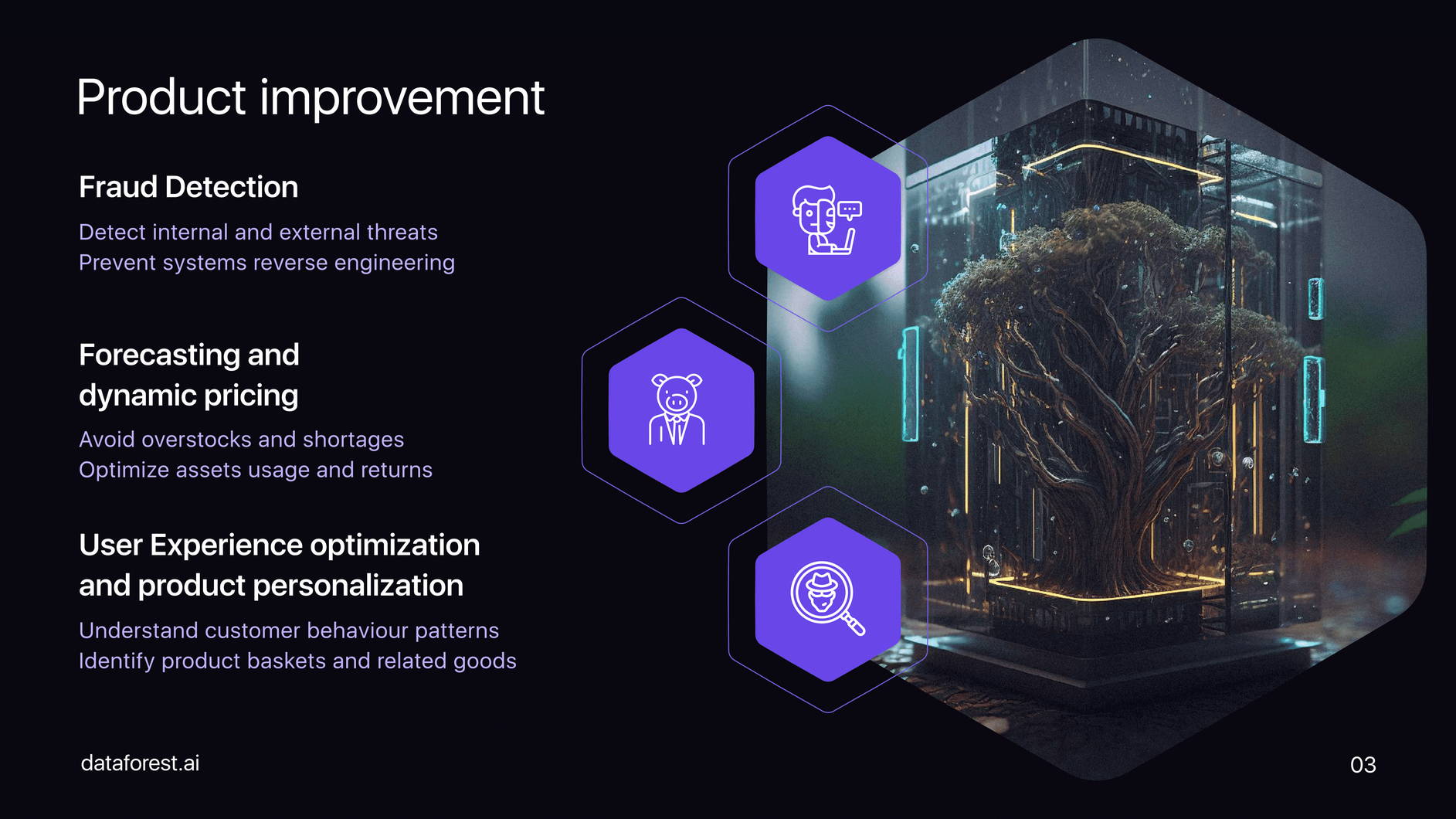
Product Improvement AI
Within the realm of product improvement AI, there are three key domains worth exploring:
- Fraud detection involves using AI tools and scenarios to detect and prevent fraudulent activities from internal and external actors. It also helps safeguard against system reverse engineering.
- Forecasting and dynamic pricing: Forecasting is particularly relevant for products dealing with physical goods, aiming to avoid stockouts and ensure customers can always purchase items. Additionally, dynamic pricing allows businesses to adjust prices based on market conditions, optimizing revenue streams.
- User experience optimization and personalization: This field focuses on better understanding customer needs to deliver tailored recommendations and improved user experiences. Businesses can provide targeted offers and interactions at the right time by analyzing user data.
Select what you need and schedule a call.
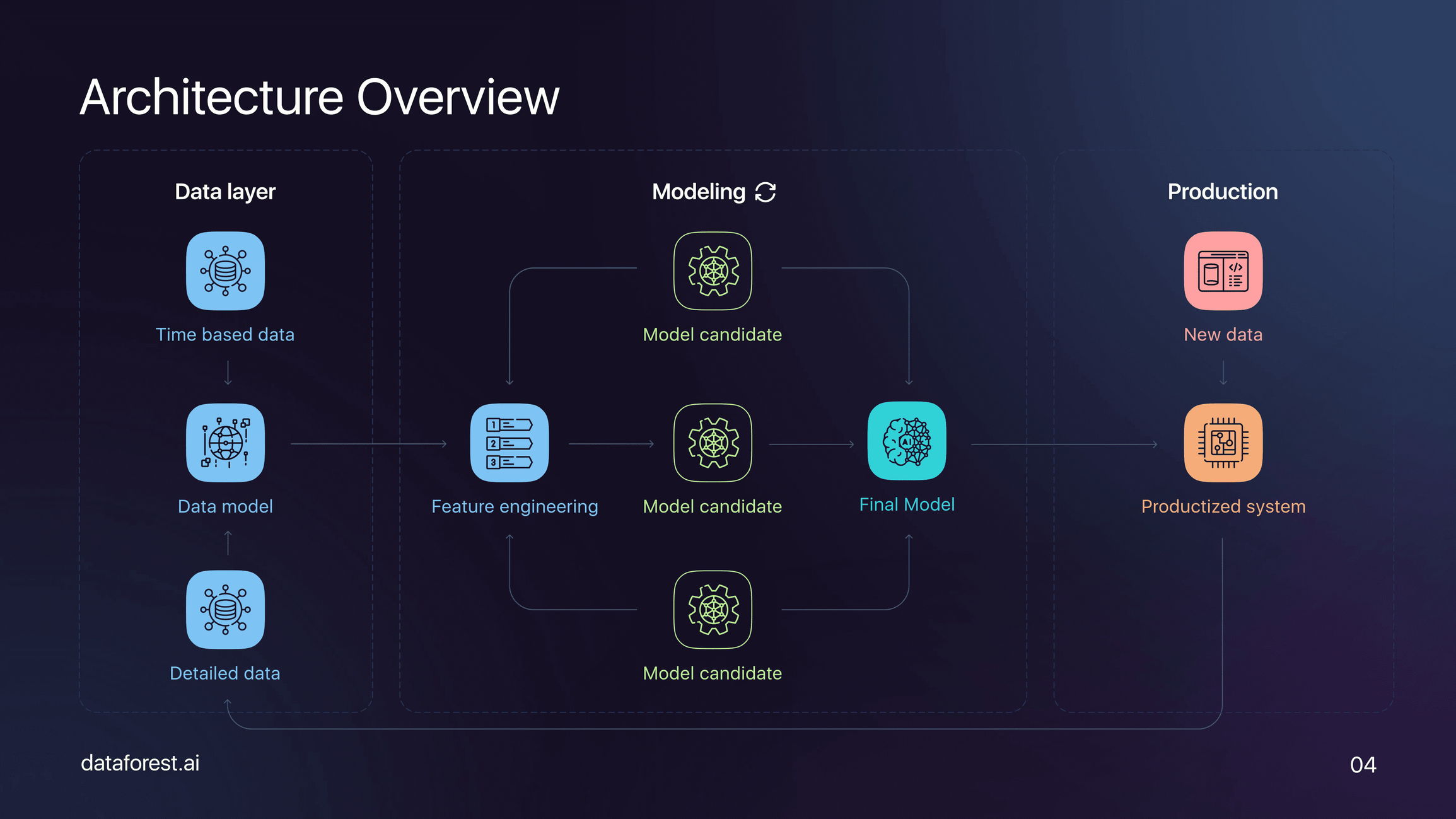
Implementation Architecture
Regardless of the specific AI tasks we undertake, the core implementation architecture has evolved into a highly automated ecosystem. It still fundamentally relies on the data layer, where historical and transactional data is instantaneously augmented with real-time customer context and dynamic external factors like micro-weather patterns or live market trends. However, the traditional modeling phase has shifted dramatically. Instead of human engineers manually evaluating hundreds of individual data features, modern systems utilize autonomous foundation models that self-select relevant variables for tasks ranging from multi-modal generative AI to advanced regression. Once the core model is established, system projectization is handled through advanced deployment operations. Moving beyond basic MLOps, today's pipelines automatically self-correct and continuously deploy updates, ensuring models remain highly effective and seamlessly integrated into production without manual bottlenecks. This architecture enables data-driven AI to operate as a continuous decision-making layer rather than a static analytical component.
Real-Life Use Cases
Now, let's explore some real-life cases and scenarios where AI implementation can have a significant impact on your business:
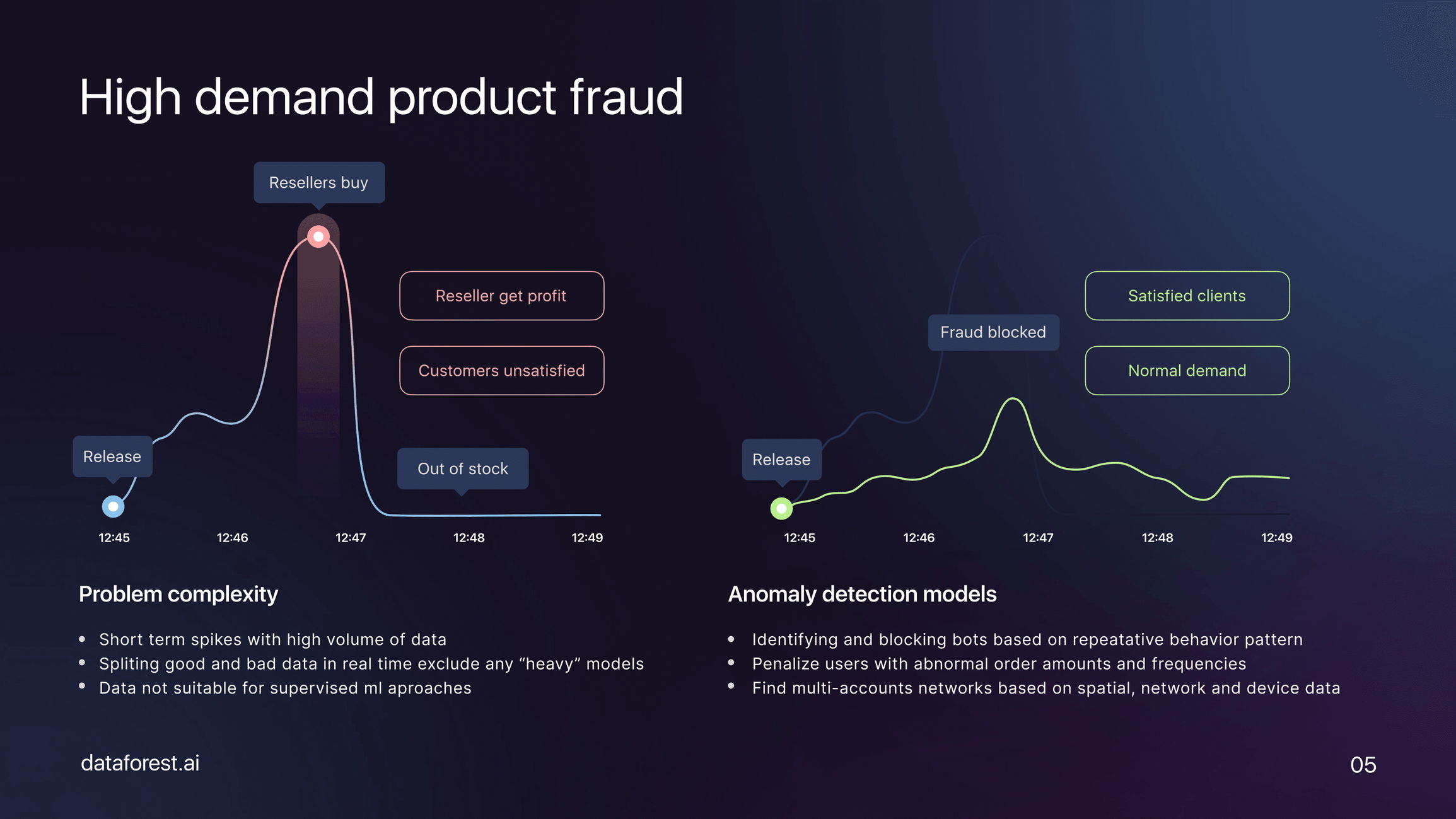
- High-demand product fraud is particularly relevant for digital and physical goods, such as limited-edition items or tickets. Using AI, we can analyze data to identify and prevent fraudulent activities during high-demand events, ensuring customer satisfaction and avoiding negative feedback.
- Internal trade fraud: Many retail chains struggle with internal trade fraud, which can be costly to detect and prevent manually. By applying machine learning techniques, such as slicing and baseline analysis, we can identify anomalies and potentially fraudulent activities, saving business time and resources.
Suppose Nike releases a limited edition of sneakers that sells out within minutes. As usual, sales spike immediately after the release, resulting in fast shortages and customer dissatisfaction, which can ultimately harm the brand's reputation.
The complexity of tackling this problem lies in the large volume of data generated during these high-demand periods. Simple AI technologies and statistical methods are insufficient due to the sheer amount of data involved. It becomes critical to gather a significant amount of data and patiently wait until the spike subsides. In real-life situations, time is of the essence, leaving us with very limited moments to decide whether to complete a transaction or not. We cannot rely on classical matching techniques as we lack the knowledge to distinguish between legitimate customers and potential fraudsters. Consequently, it becomes important to identify patterns using an anomaly detection subset of AI.
To the right, you will find a diagram illustrating a real-life scenario that effectively eliminates approximately 80% of fraud cases. This solution consists of three layers. The first layer is relatively simple, focusing on differentiating between bots and real humans. Computers find it easier to detect patterns, as humans do not act linearly. Human behavior involves mistakes, like pressing incorrect buttons, excessively long presses, or rapid actions. In contrast, bots typically follow predictable patterns that can be identified and analyzed.

The second layer also addresses non-human solvable cases. For instance, let's examine the scenario where you want to penalize users who purchase excessive items. It is reasonable to assume that no one needs 100 pairs of sneakers monthly or yearly. However, determining what constitutes normal user behavior might be challenging. An average user purchases around 12 to 18 pairs of sneakers per year. Making an incorrect decision based solely on personal experience could lead to losing valued clients who genuinely engage with your business, or you may inadvertently allow a few bots to affect a significant portion of your customer base—especially if you have only limited stock available. AI can effectively address this challenge and find a balance.
Last but not least, an essential aspect of the success of the first two layers is detecting multi-account usage. Treating separate accounts independently will not yield the desired results. This brings us back to the concept of anomaly detection. By gathering personal information, network data, and device details and utilizing neural networks and anomaly detection techniques, we can establish connections among various events, forming a multidimensional array to identify and link related accounts.
In summary, addressing high-demand product fraud requires an approach that combines anomaly detection, pattern recognition for distinguishing between bots and humans, identification of unusual user behavior, and detection of multi-account usage. By leveraging these AI techniques, businesses can effectively mitigate fraud risks and provide a more secure and satisfactory user experience.
In both scenarios, Data Science plays a crucial role. Augmenting it with relevant information, such as shipment details or trade history, helps us detect and prevent fraudulent behavior effectively.
Implementing data-driven AI in these cases requires a multidimensional approach, combining techniques like anomaly detection, behavioral analysis, and multi-account identification.
Data-driven AI can be crucial in improving business processes, enhancing customer experiences, and mitigating fraud risks. By leveraging historical and real-time data, businesses can gain valuable insights and make informed decisions that drive growth and success.
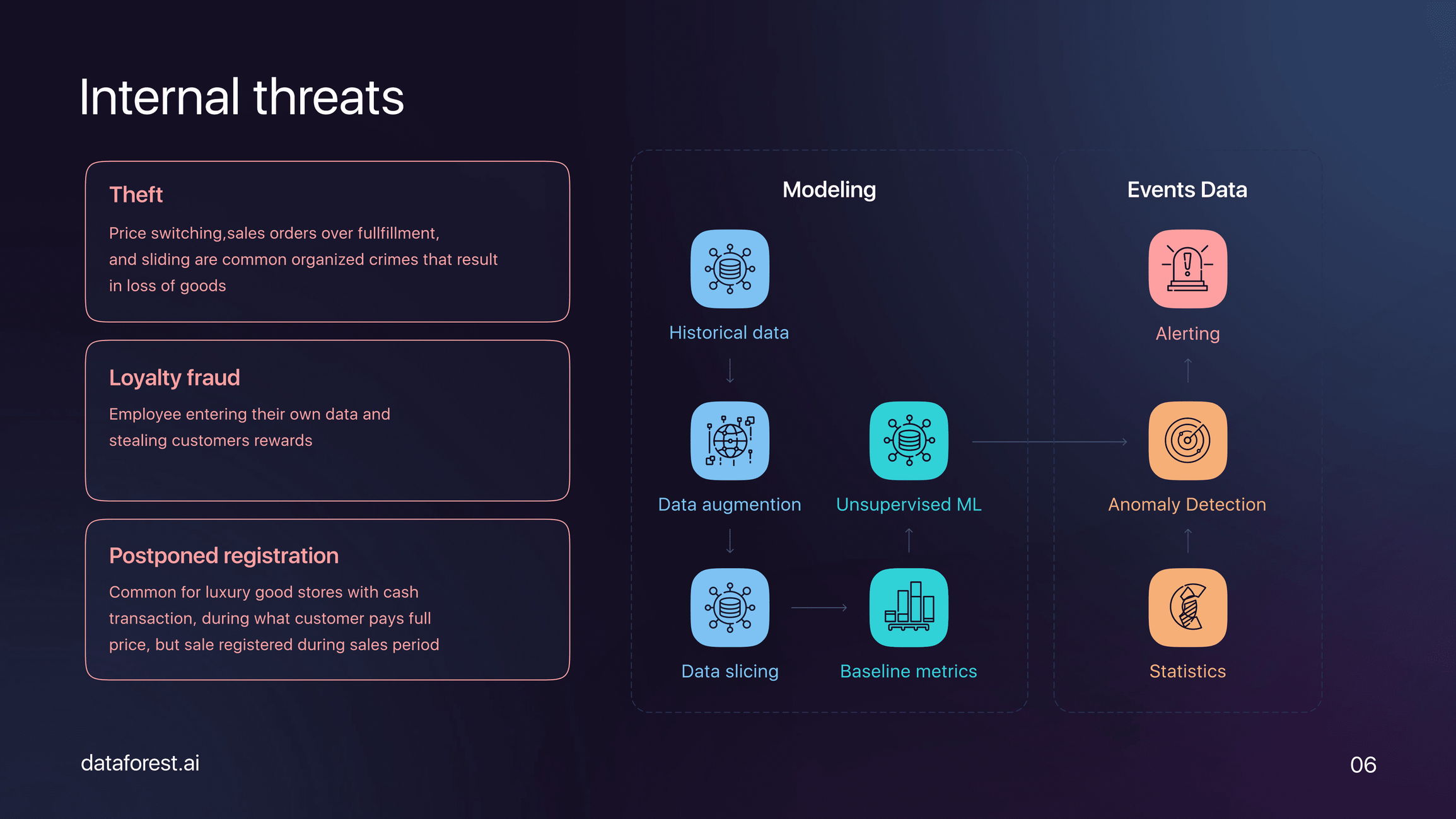
Now, let's discuss the second case, which involves addressing internal fraud. There are numerous internal threats, and although solving this issue manually is possible, the high cost makes it prohibitive for modern retail chains. Hence, employing machine learning becomes necessary. As always, we begin by collecting and analyzing data, augmenting it with the required information in the initial stages, and then proceeding with slicing and establishing baseline metrics.
This step depends on the desired outcome. Suppose we consider sales orders or fulfillment; in that case, internal fraud activities typically involve salespeople modifying items ordered, resulting in organized crime, for example, attaching additional jackets to every pair of trousers before reselling them to personal associates. We can slice the data by items, assigning weights to each item and including information about each shipment's weight. With this, DATAFOREST can identify anomalies against human patterns and perhaps not eliminate the fraud problem but at least narrow down the areas that require further investigation.
Similarly, fraud is much more straightforward to detect as we can analyze movements across multiple accounts, monitor the transfer of coins or points to reality cards, to and from accounts, and detect discrepancies between expected and actual transactions to identify bad actors.

Handling more complex fraud cases related to luxury goods stores, which operate primarily with cash, requires a different approach. For instance, managers might register transactions only during discount periods, making it increasingly challenging to track fraudulent activities. Here, we need to adopt a novel approach characterized by a broader range of evaluation metrics that re-evaluates the entire dataset, including information previously deemed irrelevant.
Addressing internal fraud entails analyzing and augmenting data, slicing it to establish baseline metrics, and analyzing anomalies in human patterns to identify areas that require further investigation. Employing machine learning techniques helps us detect discrepancies in transaction movements across multiple accounts and enables us to evolve our evaluation metrics and identify more sophisticated fraud cases.
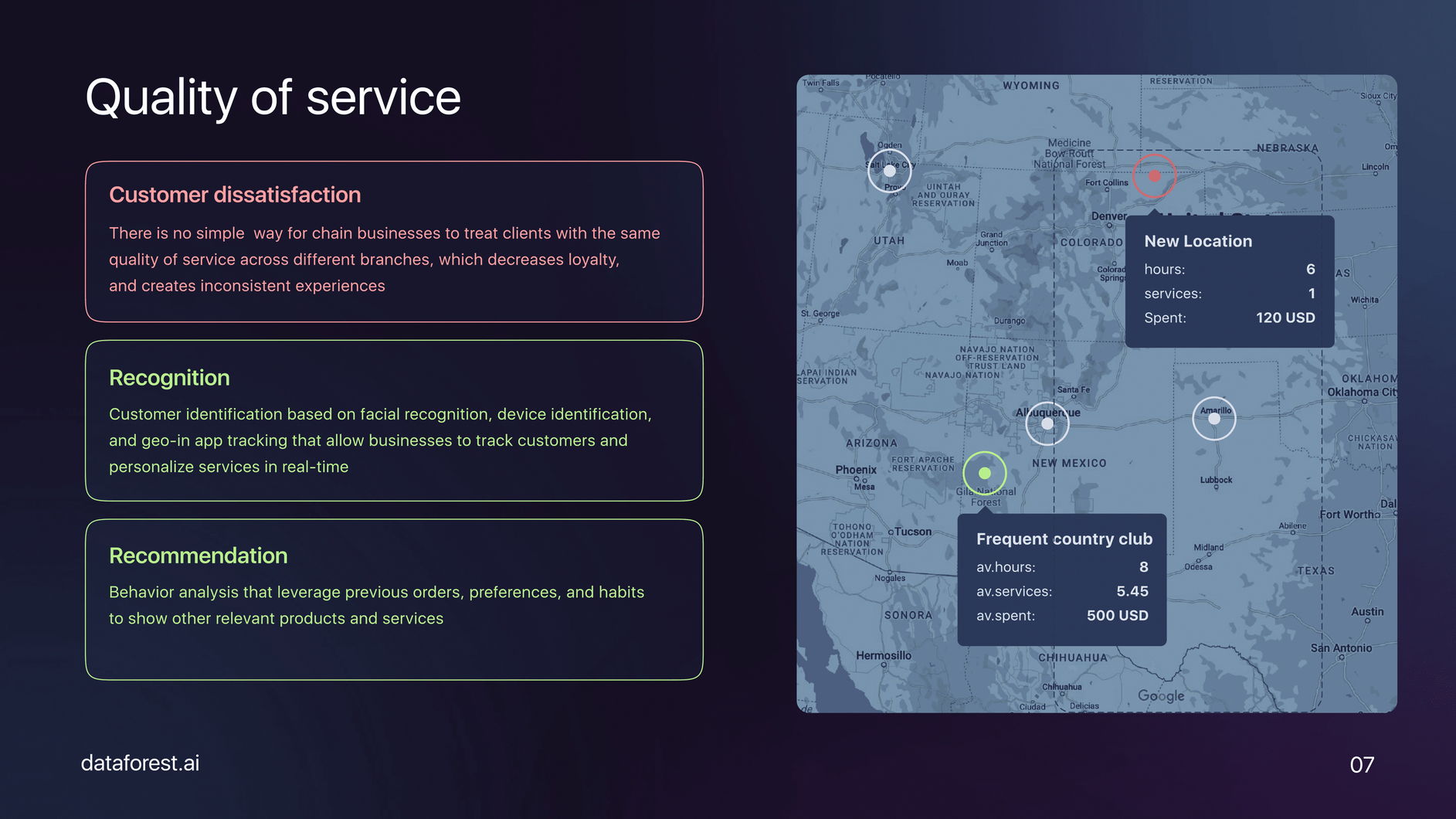
We partnered with a client who owns a golf club in the United States to solve an engagement inconsistency: frequent, long-term members were spending the same amount of time at various clubs within the chain, but consuming fewer services and spending less money at certain locations. To solve this, we implemented two modernized AI layers powered by data-driven AI.
Firstly, we upgraded their customer recognition infrastructure. Moving past reliance on basic smartphone Wi-Fi connections, we deployed a privacy-first ambient intelligence network utilizing advanced computer vision, spatial tracking, and device handshake technologies. This seamlessly logs a customer's presence the moment they arrive.
Secondly, we deployed an autonomous recommendation engine. Rather than staff looking down at static customer profiles on tablets, they now receive proactive, real-time insights via discrete wearables or spatial interfaces. The system instantly synthesizes a member's network-wide history, preferences, and habits to suggest highly personalized recommendations at the exact right moment. By providing these hyper-tailored experiences effortlessly, this approach has proven to increase revenue by 2.5 times for customers visiting a country club location for the first time.
If you're looking for more real-life examples of how data science and machine learning can benefit various industries, discover more helpful DATAFOREST cases! From enhancing business operations to improving decision-making processes, these case studies will inspire you and provide specific solutions for implementation. Don't wait any longer; head to the website and explore the endless possibilities of Big Data, ML, and AI!
Implementation of AI
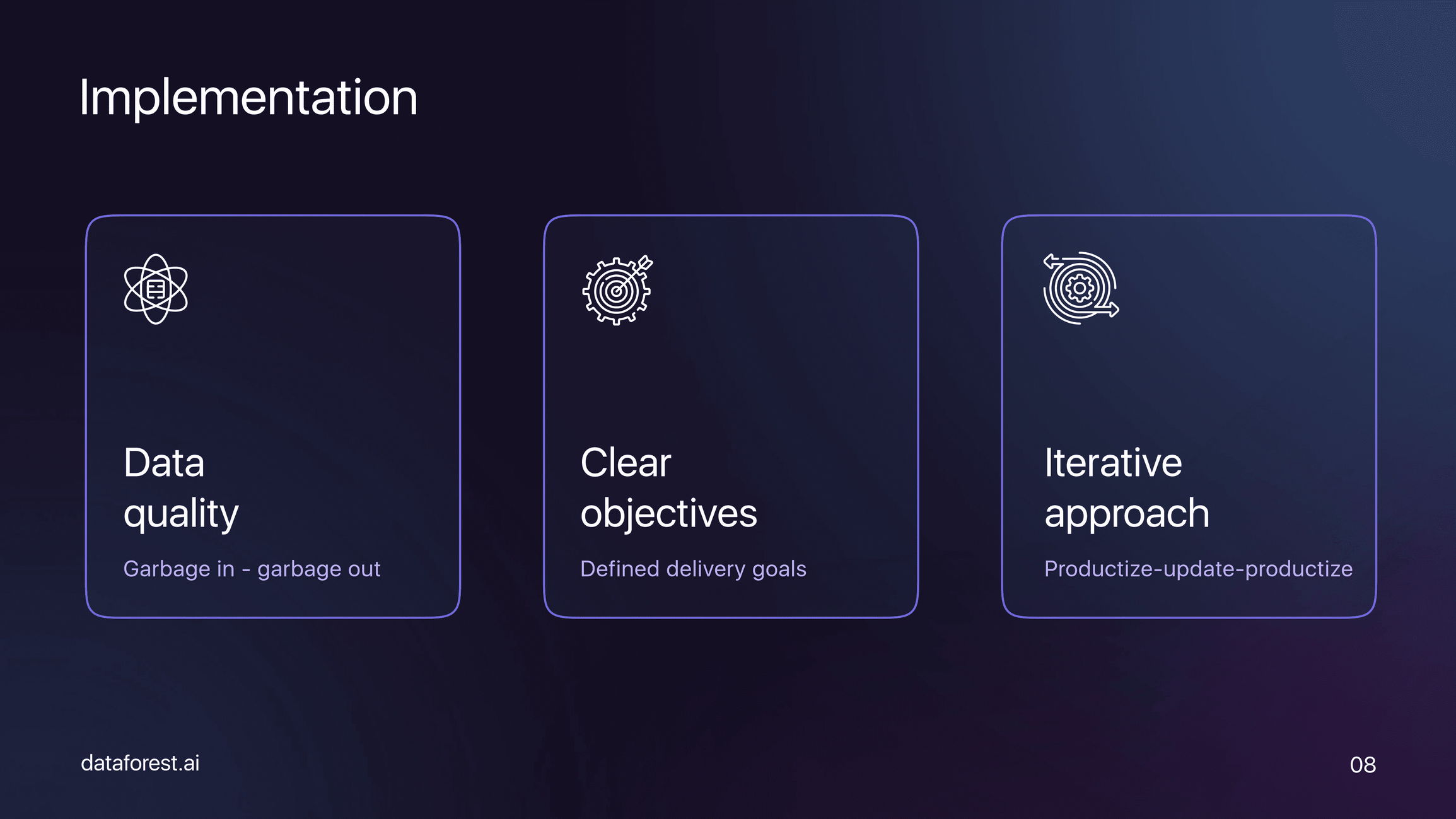
AI has transitioned from a competitive advantage to essential infrastructure across all industries. Whether you are integrating autonomous systems into physical supply chains or hyper-personalizing the hospitality experience, the fundamental driver of success remains high-fidelity data. Data-driven AI connects that data foundation with actionable intelligence, helping organizations turn complex information into measurable business outcomes. Deploying these systems effectively requires clear strategic alignment and a creative approach to complex problem-solving.
Instead of stalling in the pursuit of a "perfect" static model, a modern AI solution demands continuous adaptation. Prioritize live deployment, automated feedback loops, and dynamic model updating. Embracing this self-optimizing cycle is the only way to keep pace with evolving business challenges. The integrity of your data ecosystem dictates the ceiling of your AI's capabilities, making a resilient data strategy non-negotiable.
With next-generation architecture and a proven track record, DATAFOREST provides the tools and expertise to build data-driven AI workflows. Leverage our solutions to unlock predictive insights, autonomously optimize operations, and drive real-time, data-backed decisions. Take this opportunity to transform your business into a forward-thinking, AI-driven enterprise.

.svg)
.webp)
.webp)
.webp)


